
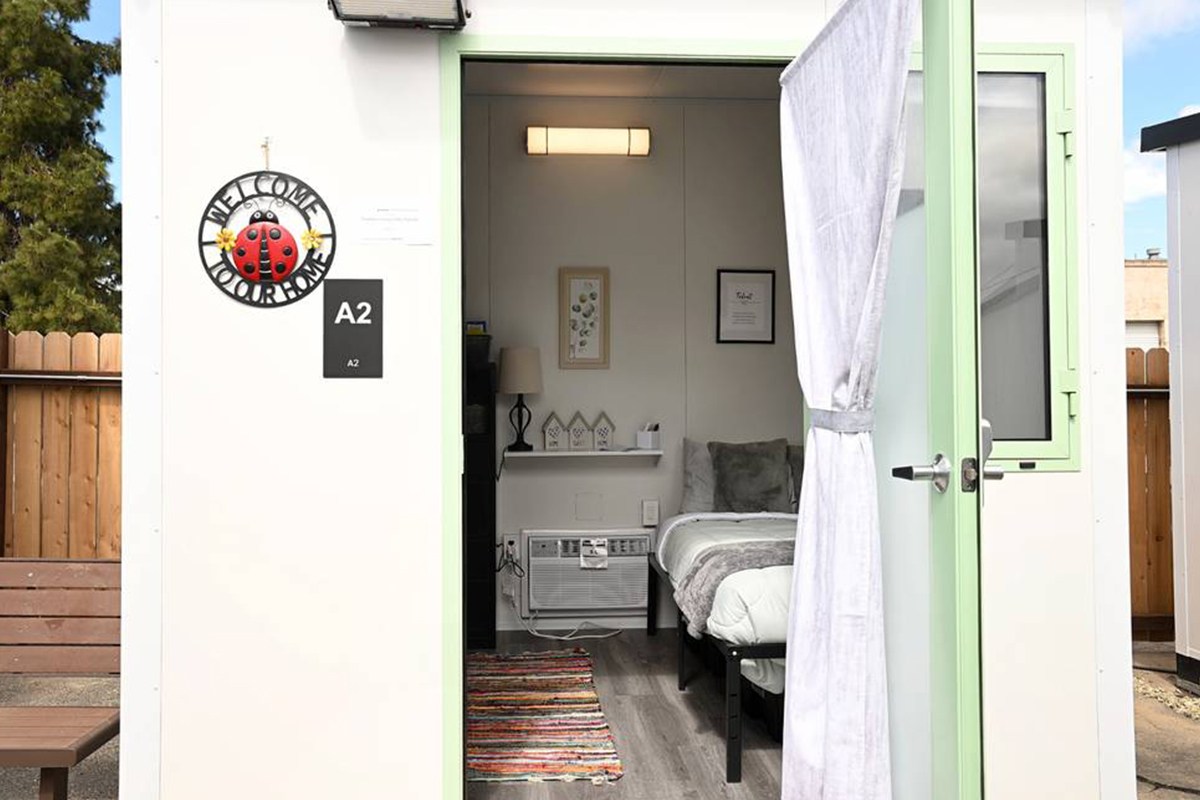
Cities across California are opening interim supportive housing communities in months, not years. The communities that move fastest follow a similar playbook: pick the right site early, line up an experienced operator, use a procurement path that avoids delays and choose units that can be delivered and installed quickly. Here’s how to get started.
1. Find the right site
The best sites are already publicly owned or can be leased long term, have access to utilities and are close to transit and services. Many successful communities reuse underused land:
- Parking lots, like 1979 Mission St in San Francisco or the Sun Valley Metrolink station lot used for Olinda Tiny Homes Village in Los Angeles.
- Vacant public or agency land, like the Valley Water lot for Cherry Avenue in San José, leased through 2035.
- Former institutional sites, like La Posada on the former juvenile hall site in Santa Barbara County.
2. Line up funding
Interim communities are often funded through a mix of state grants, local measures and philanthropy. California programs such as Encampment Resolution Funding and Behavioral Health Bridge Housing have supported many recent projects. Cherry Avenue, for example, combined state funding, a local measure and philanthropic donations.
3. Choose an operator and service partners
Private rooms get people inside, but services move them forward. Bring in an experienced operator early to shape the site plan, staffing, case management, meals, security and behavioral health care.
4. Use a fast procurement path
Procurement can take longer than construction. BOSS holds a California DGS statewide contract for emergency sleeping cabins, which gives public buyers a pre-negotiated path to purchase units without starting a new bidding process from scratch.
5. Design for dignity and durability
- Private rooms with a locking door, heating and air conditioning and a window
- Restroom, shower and laundry buildings, or ensuite units
- Community space, case management offices, outdoor areas and a pet area
- Durable construction built for years of daily use
BOSS units use steel panel construction with integrated HVAC and pre-wired electrical, and are available in individual, couples, family and ADA-accessible configurations.
6. Build site and units at the same time
Because BOSS units are manufactured in our factory while the site is graded and utilities are installed, the two phases overlap. Panels ship on flatbed trucks and are assembled on site without heavy equipment.
7. Plan for what comes next
Some communities are designed to relocate once a lease ends; others become long-term assets. Building with durable units gives cities options.
Ready to start?
Talk with our team about your site and timeline, see communities we’ve helped build or learn more about BOSS for cities.
Leave a Reply